Petrol or Electric? Choosing an Enduro Bike
Nati Abargel
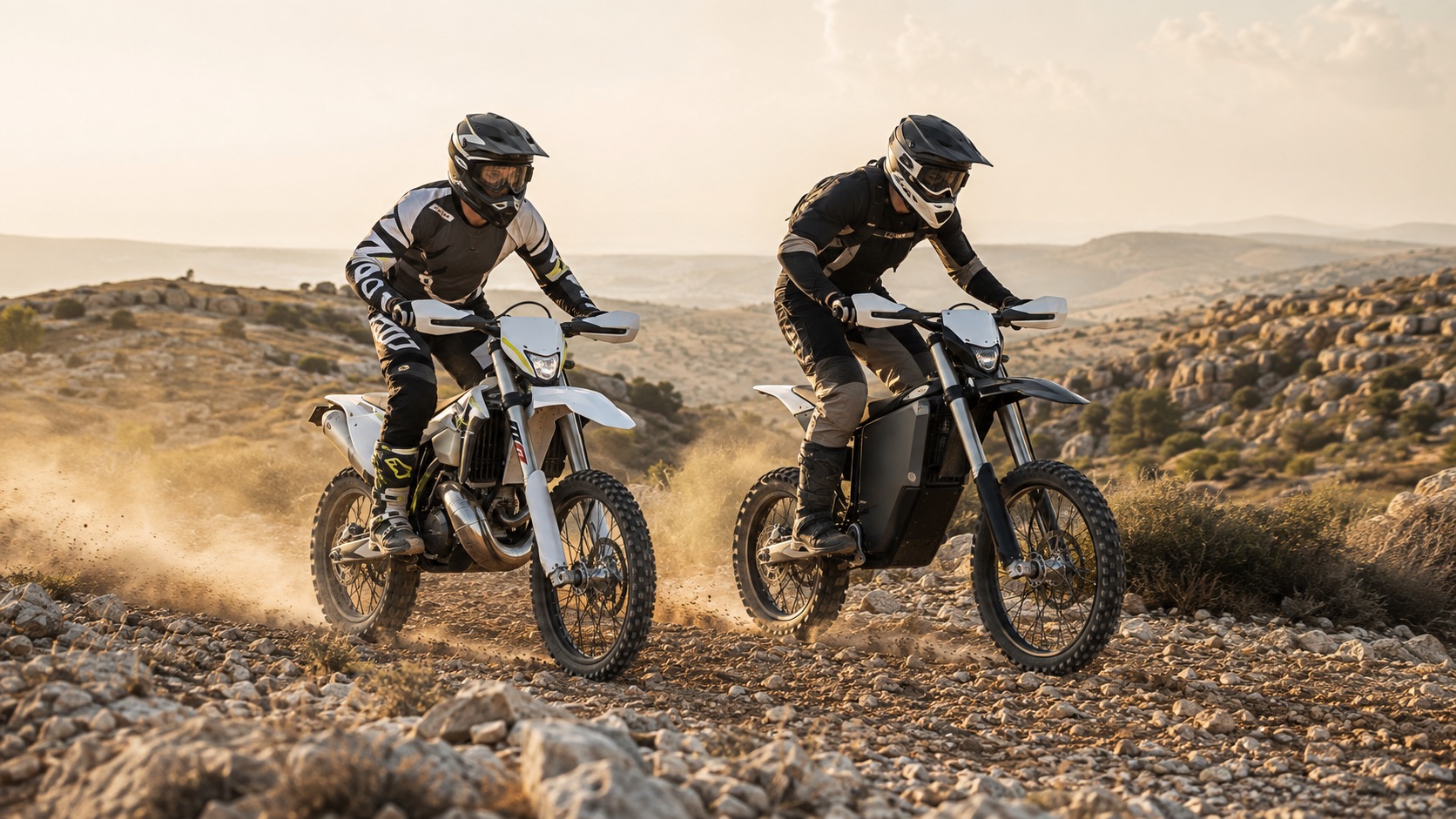
If you had asked a few years ago whether an electric motorcycle could be a real enduro bike, most riders' answer was short. Today the question is different: not whether electric is capable - but who it suits, in what kind of riding, and what you pay for its advantages.
- 1. First, compare machines from the same category
- 2. The quick comparison
- 3. How they feel on the trail
- 4. Range, refuelling and charging: this is where the decision is made
- 5. Maintenance and cost of ownership: less is not zero
- 6. Weight, fatigue, and picking the bike up after a fall
- 7. Noise, the environment, and access to the trails
- 8. What suits a beginner
- 9. What an experienced rider gains
- 10. What to check before buying
- 11. The decision test
- 12. The bottom line
- 13. On a personal note
- 14. Frequently asked questions
- 15. Sources and fact-checking
There is no outright winner here. A petrol bike still offers the simplest freedom of movement and logistics for a long day. An electric bike offers precise control, silence and less engine maintenance. Both can be fast, both can be expensive, and both will drop you on exactly the same rock.
This guide is for the rider choosing a first bike and for the experienced rider considering adding an electric to the garage. The goal is not to convert you to either side - it is to help you choose by the riding you actually do.
The short answer: if your riding day is long, unpredictable and far from a power socket - petrol is still simpler. If most of your rides are technical sessions of a few hours, you can charge at home and silence matters to you - electric may fit better. Everything in between depends on the model and the route, not on the drivetrain alone.
1. First, compare machines from the same category
The most common mistake in this debate is comparing a light electric trail bike to a full-size enduro machine, or a competition electric to a 125 two-stroke. "Electric" is not one kind of motorcycle, and neither is "petrol".
On the electric side there are at least three families today. The borders are informal, but the split makes it clear what is actually being compared:
- Light electrics, like the Sur-Ron Light Bee and Talaria Sting. Narrow, light and simple to operate, but not always offering the wheels, suspension, brakes, range or registration of a proper enduro bike.
- Mid-weight electrics, like the Sur-Ron Ultra Bee and the Talaria Komodo. Much closer to a dirt bike in dimensions and components, and still lighter than many full-size enduro machines. This is where the most interesting growth in the Israeli market is happening right now.
- Full-size electric motorcycles, like the Stark VARG EX. Aimed directly at the frame, suspension, wheels and performance of competition enduro and motocross bikes - and approaching them in weight and price too.
On the petrol side there is a wide gap between two-strokes, four-strokes, small capacities and powerful 450s. A light, flexible 300 two-stroke does not feel like a 450 four-stroke, even though both burn petrol.
The Komodo shows why this split matters. By the manufacturer's figures it weighs 98 kg, comes with 21-inch front and 18-inch rear wheels, a 97.2-volt, 45-amp-hour battery and a peak output of 32 kW. In other words, it is not a small leisure toy - but it is not a 120 kg full electric either.
In Israel it is already far more than a promise on paper. As of August 17, 2026, 533 Komodo units had been registered here since the start of the year - more than any other electric model, and 26.2% of all new electric motorcycle registrations in that period.
For scale only: KTM publishes 104.7 kg without fuel for the 2026 300 EXC, Talaria publishes 98 kg including the battery for the Komodo, and Stark publishes 120 kg for the VARG EX. The measurement conditions and intended use are not identical, so this is not a "who is lighter" table. It shows something more important: the drivetrain alone no longer tells you how big a bike is, what it weighs, or who it is for.
The rule: compare bikes built for the same job, not two technologies in the abstract.
2. The quick comparison
| Topic | Petrol | Electric |
|---|---|---|
| Power delivery | Clutch, gears and an engine character that varies | Instant, continuous power, adjustable on most machines |
| Ease of operation | Clutch and gears must be learned | No stalling and no gear changes |
| Range | Relatively easy to predict and extend with more fuel | Depends heavily on pace, terrain, sand, climbs and power mode |
| Energy recovery | None | Regenerative braking on some models; its contribution varies |
| Continuing the day | A few minutes of refuelling | Meaningful charging time, unless the battery is swappable and a spare exists |
| Engine maintenance | Oils, filters, plugs and engine services by model | Far less, but not zero |
| Chassis wear | Tyres, chain, brakes, bearings and suspension | Exactly the same items |
| Noise | A central part of its presence, and of the friction with everyone else | Far quieter, but not silent |
| Trailside repair | More systems to deal with, but common knowledge and parts | Fewer mechanical failures; a deep electrical fault is hard to improvise around |
| Tuning the bike's character | Engine maps and some controls, within a limited window | Usually a wide range of power, throttle response and regen braking |
| Suitability for an unplanned day | High | Requires charge and range planning |
The table gives direction, but it does not tell you how the bike feels when the climb steepens and your pulse rises. That is where the real difference starts.
3. How they feel on the trail
Electric: precision without ceremony
Turn the throttle and the power is simply there. No wrong gear, no engine stalling mid-ledge, no finger burning on the clutch after an hour of tight singletrack. That frees attention: instead of managing revs, gear and clutch, you can concentrate on the line, on grip and on body position.
But easy to operate does not mean weak or forgiving. A powerful electric motor can put enormous force to the rear wheel in an instant. For a beginner, a calm power map and a soft throttle response are learning tools. Full power mode is not a medal to unlock on day one.
Being able to change power, throttle response and regen braking lets the same bike go from soft and comfortable to precise and aggressive. It is not just an app gimmick: the right change can help hold grip in mud, reduce fatigue in rocks, or simulate more engine braking on descents.
Petrol: more work, but more tools in your hands
A clutch and gears add workload, but they also give a different kind of control. You can store energy in the flywheel, slip the clutch, pick a gear that softens the power, and use the engine's sound to know what is happening without looking down.
On a two-stroke the feel is usually freer and lighter, with less engine braking. On a four-stroke the power is generally more linear and the engine braking is felt on descents. Experienced riders use these differences as part of their technique, not just as character.
Crossing between the worlds requires recalibration. A petrol rider on an electric tends to reach for a clutch that is not there and judge speed by a noise that is gone. A rider who learned only on electric will have to learn clutch, gears and rev management if they ever switch to petrol.
4. Range, refuelling and charging: this is where the decision is made
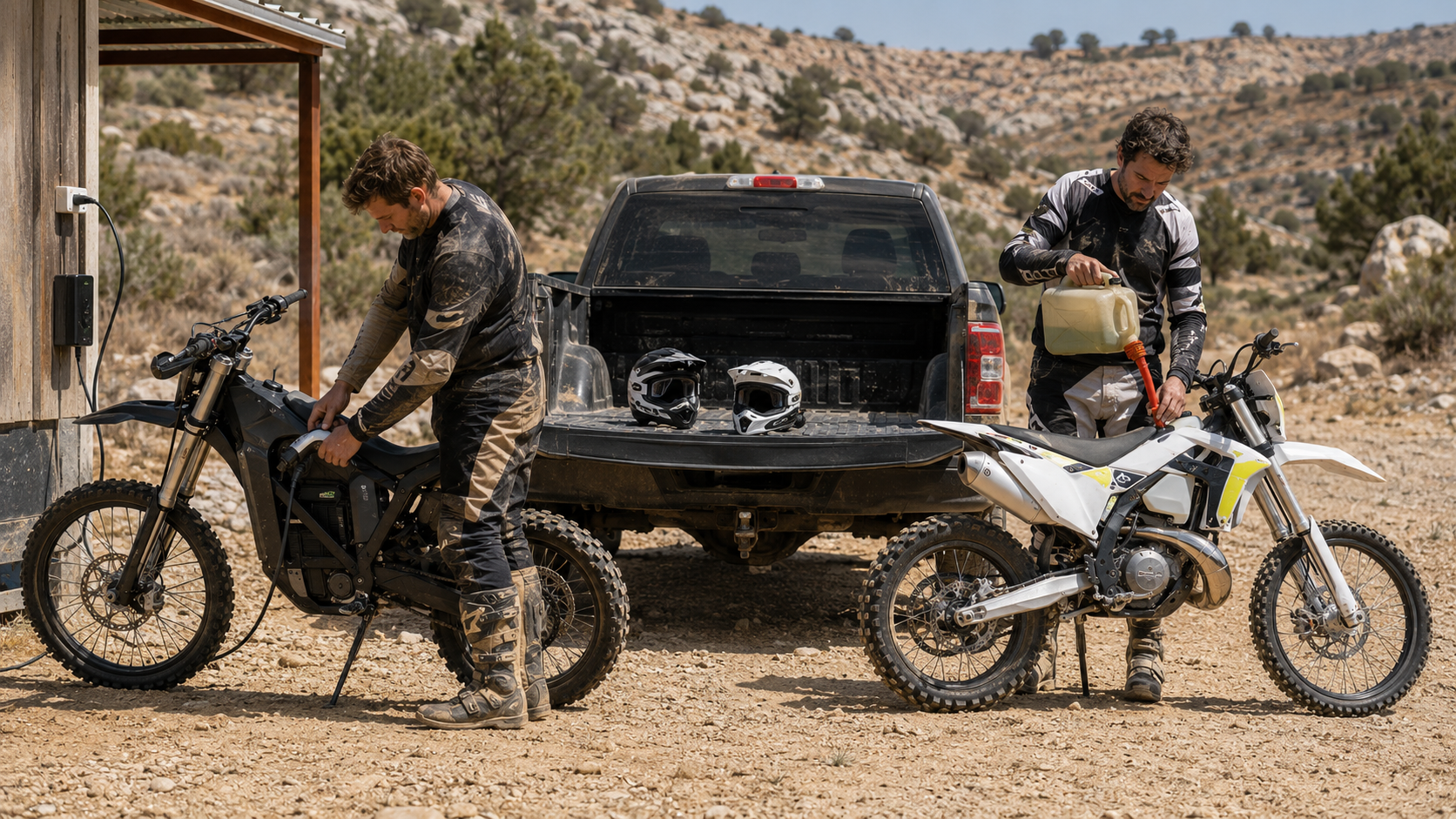
On petrol, even when range is limited, the solution is simple: stop, refuel, carry on. You can carry a little approved fuel, return to the vehicle, or plan a station. A few minutes restore almost all of the range.
On electric, the figure that matters is not just battery size but how you ride. Energy consumption changes with:
- Average speed and how open the throttle is
- Climbs and elevation gain
- Deep sand and mud
- Rider and gear weight
- Tyre pressure or mousses, and rolling resistance
- The power map and regen braking
- Temperature and battery condition
Manufacturers do not even present range the same way. Some publish riding hours, others publish distance at a fixed speed. Talaria, for example, claims up to 115 km for the Komodo at 45 km/h, while Stark claims up to six hours of trail riding for the VARG EX. The numbers cannot be compared directly, and neither is a promise about an Israeli enduro route.
Slow technical singletrack can be very economical; fast trails, sand and long climbs can drain the same battery at an entirely different rate. A manufacturer figure is a reference point, not a riding plan.
Charging times differ just as much. Talaria quotes a fast charge from 10% to 80% in about an hour with the right equipment; on other models a full charge can take an hour, two, or more, depending on battery, charger and socket. Before buying, check which charger actually ships with the Israeli version, what connection it needs, and whether you have the right infrastructure at home or in the field. A fast charger with no matching socket in your parking spot shortens nothing.
A good planning rule for electric
On your first rides, go out on a familiar route, check how many percent were consumed against time, distance and terrain, and turn around early. Do not plan by the manufacturer's figure before you have built your own. Keep a reserve for finding a friend, a detour, a navigation mistake or a climb you attempt twice.
If almost every ride ends with the same group, in the same area, inside a fixed time window - an electric's range is easy to learn. If your ride starts with "let's see where we end up", petrol gives you far more freedom.
5. Maintenance and cost of ownership: less is not zero
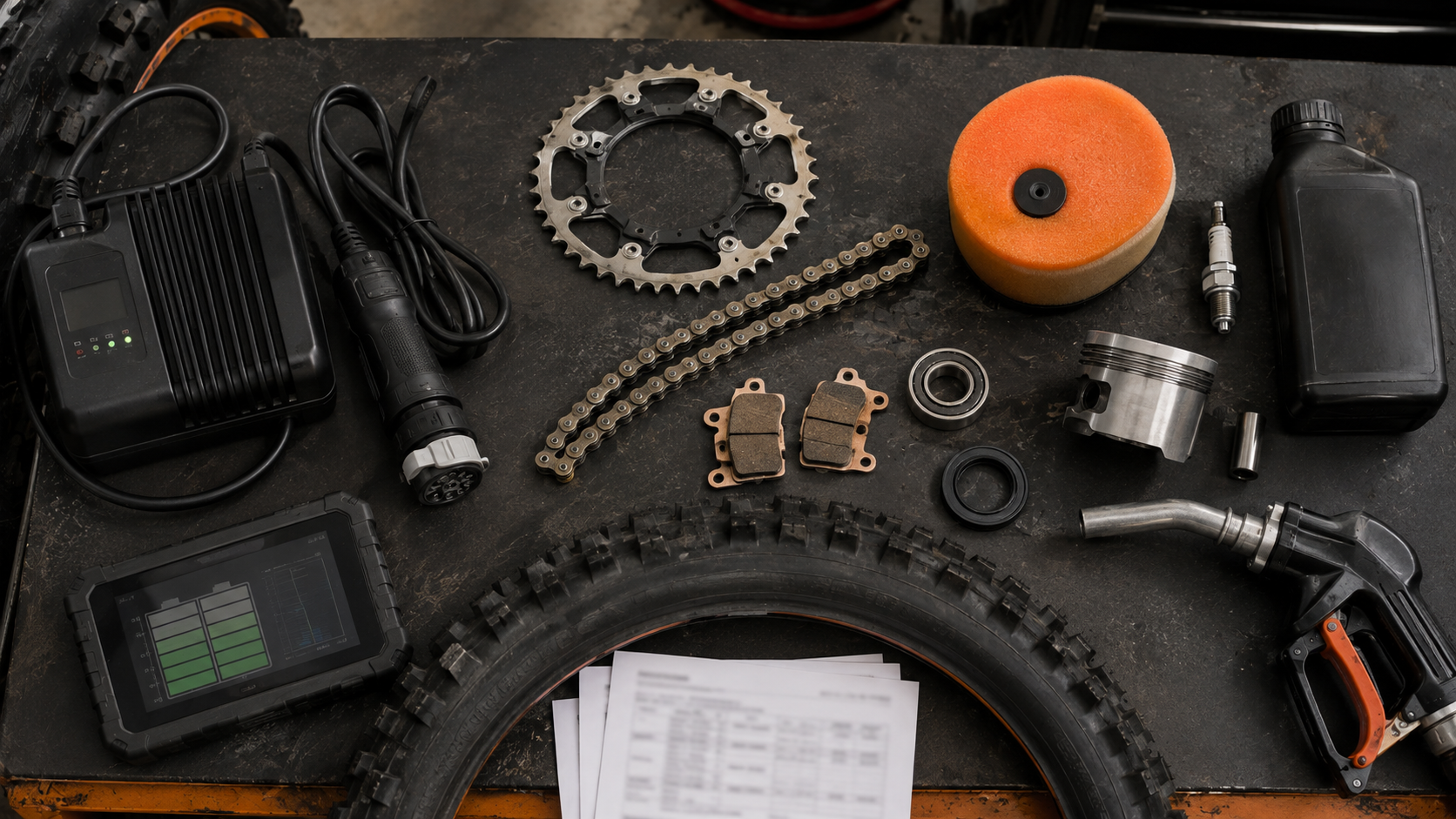
An electric bike has no piston, valves, spark plug, fuel injection or engine air filter. Drivetrain maintenance is genuinely simpler, with fewer fluids and fewer parts worn by heat and combustion.
But an electric bike is still a dirt bike. It keeps consuming:
- Tyres, tubes or mousses
- Chain and sprockets
- Pads and discs
- Wheel, steering and linkage bearings
- Suspension oil and services
- Plastics, levers and pegs every time the rock wins
The drivetrain itself can still have a transmission, gearbox oil, coolant and periodic checks - depending on the model. Some motors are air-cooled and some liquid-cooled; some batteries are swappable and some are not meant to come out for a quick trailside stop. "No engine oil changes" is not "no servicing". Read the model's service book, not general assumptions about electricity.
On petrol, the scope of maintenance depends heavily on engine type and use. Two-strokes and four-strokes are not the same story, and race pace is not relaxed trail riding. Work from the service book for the model and year, not from a number you heard in a car park.
So which is actually cheaper?
Electricity per kilometre is usually cheaper than fuel, but in enduro the energy cost is only a small part of the story. Tyres, mousses, wear, depreciation, transport and repairs can all be bigger line items.
On electric, also check the battery warranty, the price of a replacement battery, parts availability and the importer's diagnostic capability. On petrol, check engine hours, rebuild history and the availability of a workshop and parts.
So do not ask "how much does it cost to fill up". Ask: what will it cost me to own this bike for three years, and what is the most expensive repair that could arrive in that time.
6. Weight, fatigue, and picking the bike up after a fall
On light electrics, the low weight is an enormous advantage for a beginner: easier to correct a line, easier to stop, and much easier to pick the bike up. But they are not always a full substitute for an enduro bike in components, legality and range.
The mid-weight category changes the picture. A Komodo at a claimed 98 kg is lighter on paper than many enduro bikes, and still comes with full enduro wheel sizes. At the other end, a full-size competition electric can reach about 120 kg. So "electric is heavy" is true of some models and completely wrong about others.
And still, the number is not the whole feel. An electric motor has less rotating mass, there is no fuel tank changing weight through the day, and the centre of mass can sit low and concentrated. A full electric may feel lighter in motion than it feels when you have to lift it off the ground.
The test that matters is not just a demo lap. Stop on a slope, push the bike backwards, turn it around on a narrow trail, and imagine the fifth lift at the end of a hot day. That is where the real weight shows up.
7. Noise, the environment, and access to the trails
Electric is far quieter, and it changes the day. You can leave early without waking a street, talk to your friends at a stop, hear the tyre and the grip, and reduce the friction with hikers and residents.
But two things need saying precisely.
First, silence is not a permit. Licensing and trail-access rules apply to an electric bike exactly as they do to a petrol one. The fact that nobody hears you does not turn forbidden ground into permitted ground. What decides is the vehicle's registration, your licence class, and the rules of the place you are riding.
Second, silence demands more responsibility. Hikers, cyclists and animals may not hear you coming. Slow down, keep your distance, and give a friendly signal before passing. The silence is an advantage only if it is not used to surprise people.
Environmentally, an electric emits no exhaust at the point of riding and burns no fuel on the trail. The battery and the electricity still have a footprint of their own. The strongest argument in the field is local and immediate: less noise and no exhaust smoke - not a promise of zero impact.
8. What suits a beginner
Electric can shorten the operating stage: no stalling, no wrong gear, no restarting after a fall, no clutch to burn. That leaves more attention for what actually matters - vision, standing position, balance, braking and line choice.
For a beginner riding close to home or to the vehicle, in short planned sessions, an electric in a calm power mode can be an excellent teacher. A light electric adds a serious weight advantage on top.
Petrol will be the better choice for a beginner who wants to join an existing group's long riding days, tour changing areas, or buy used from a wide market. It is easier to get help from a friend, find a workshop, and continue a riding day after a refuel.
Worth remembering: if the goal is to ride petrol eventually, the clutch and gears have to be learned too. Electric teaches off-road riding, but it cannot teach operating skills it does not have.
For a broader guide to choosing a first bike, gear, licensing and costs, read The Complete Beginner's Guide to Enduro Riding in Israel.
9. What an experienced rider gains
For a veteran, electric is not "petrol without the noise". It is a tool that lets you work differently:
- Practise technical lines without managing clutch and revs
- Tune power and braking to grip and fatigue
- Ride short sessions with no warm-up, refuelling or engine fussing
- Hear grip loss, impacts and suspension action far better
On the other hand, someone who loves a long touring day, spontaneous changes of pace and the ability to add range in minutes may feel the battery is managing the day. A rider whose technique is built on sound, clutch and engine braking will need an adjustment period.
The good news is that there is no longer any debate about whether electric "can do enduro". An electric motorcycle has already completed the Gold class at Red Bull Romaniacs, mid-weight models like the Komodo and Ultra Bee are selling in real numbers, and full electrics compete at the top level. The remaining question is fit, not legitimacy.
10. What to check before buying
On any bike
- That your driving licence matches the power written on the vehicle's registration
- Road registration and usage restrictions
- Frame, wheels, suspension, bearings, brakes and chain
- Parts availability, and a workshop that knows the model
- Standing comfort, height, weight, and springs matched to your weight
- A test ride in the power mode that suits you, not only the strongest one
On a used electric
- Battery health, if the manufacturer or importer can produce a diagnostic report
- Charge-cycle count and any fault or alert history
- Real-world charging time, and the charger that comes with the bike
- The condition of connectors, cables and the charge socket, and sealing after any repairs
- Remaining warranty, and whether it transfers to the next owner
- The price and availability of a battery, charger and controller
- Software updates, the app, and whether any features require a subscription
On a used petrol bike
- Engine hours, and whether they match the general wear
- Piston or top-end history, by engine type
- Cold and hot starting, unusual smoke, noises and leaks
- The air filter and airbox - a good window into the standard of maintenance
- The cooling system, radiators, and the fan if there is one
- Service records and receipts, not just "it was serviced on time"
On any used purchase: a professional inspection before money changes hands is cheaper than one surprise after it.
11. The decision test
Mark which column describes you better:
| Choose petrol if... | Choose electric if... |
|---|---|
| Your riding days are long or unpredictable | Your rides are short or of fixed length |
| You have no regular charging at home or in your parking spot | You have a suitable, convenient socket where the bike lives |
| Your group refuels and carries on | Your group returns to the vehicles inside your range window |
| You want a wide used market and workshop network | You are buying a model with a proper importer, parts and diagnostics |
| You enjoy the clutch, the gears and an engine's character | You want precision, digital tuning and less operating workload |
| Fast refuelling matters more than silence | Silence and less engine maintenance matter more than open-ended range |
If most of your marks land on one side, the decision is probably simple. If the result is split, do not buy by an internet argument. Book a real test ride on a route that represents your actual day. Check fatigue, range, the lift after a fall and the logistics from the vehicle - not just acceleration in a field.
12. The bottom line
Petrol is still the most flexible choice. It suits a long day, a changing route, and a rider who does not want to think about sockets and charging. The knowledge, the workshops, the parts and the used market already exist around it.
Electric is already a real choice, not an experiment. It is quiet, precise, easy to operate and needs less drivetrain maintenance. For planned technical rides, and for a rider who can charge at home, it may well be the more correct bike - for a beginner and a veteran alike.
The right choice is not the bike with the most impressive figure. It is the bike that finishes the riding day you actually do, and leaves you wanting to go out again next week.
13. On a personal note
After several years of riding petrol bikes, I switched to electric. And once the excitement about the silence, the instant power and the simplicity settled a little, I found myself asking an entirely different question: had anything of what I started riding for in the first place been lost along the way?
For me, enduro was never only an engine, gears, or the sound from the exhaust. I came into this world for the challenge, the sense of achievement, facing fears, leaving the comfort zone, and that moment when you stand in front of a climb or an obstacle, certain there is no chance - and try anyway.
And there is everything around it too: the friends, the tiredness at the end of the day, the falls, the small improvement from ride to ride, and the feeling that you learn something about yourself every time you clear a place that used to stop you.
So did the electric take any of that from me? For me - no.
The motor changed. The way I manage the bike changed. Some of the skills are different. But the reason I get on it in the morning stayed exactly the same reason.
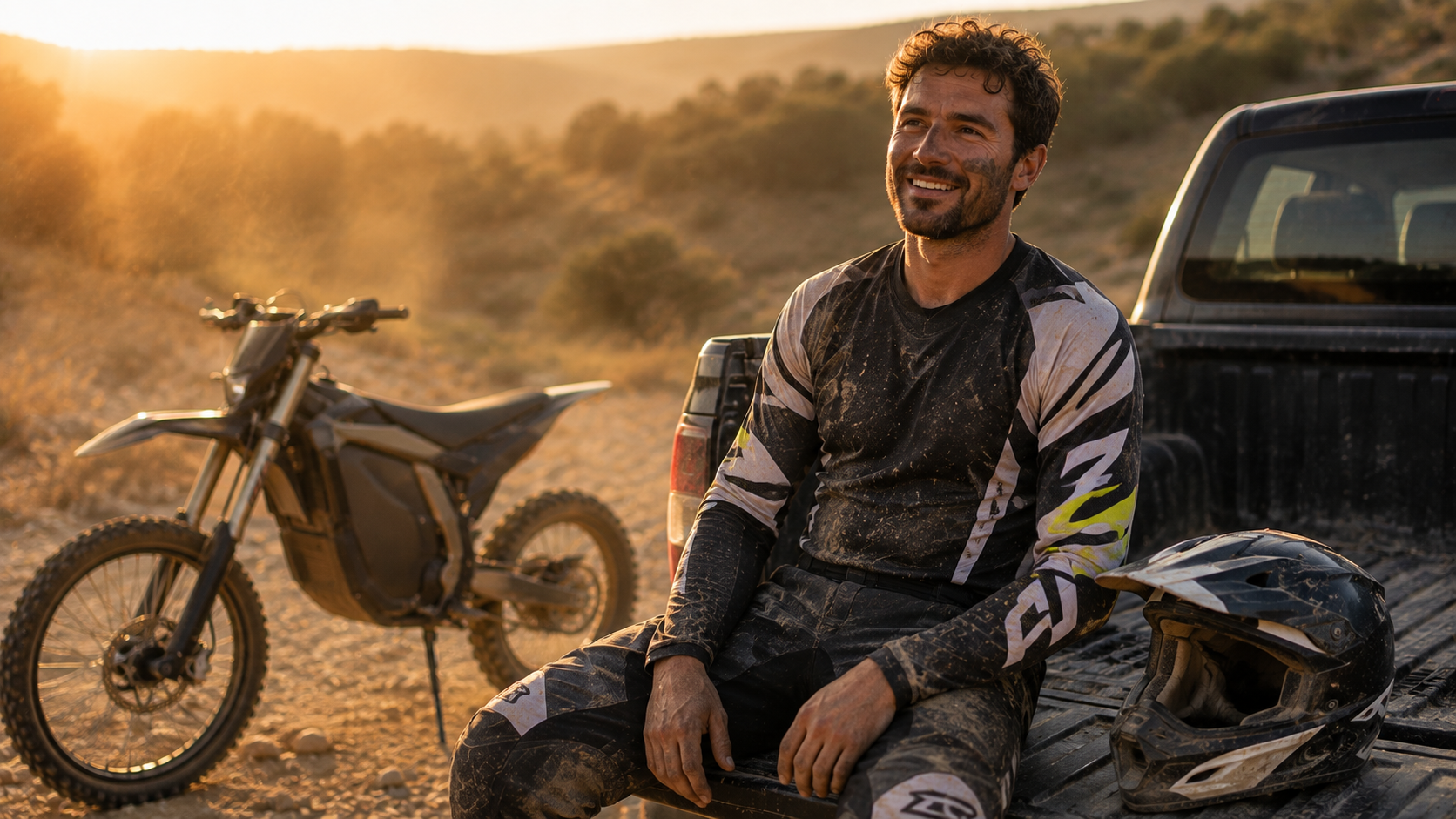
In the end, maybe the most important question is not whether your bike runs on petrol or on electricity. It is whether, when you come back from the ride - dirty, tired and smiling - you still feel it gave you what you started riding for.
14. Frequently asked questions
Can an electric bike do a full enduro day?
Sometimes, but "a full day" is not a unit of measurement. Slow technical riding can consume far less energy than fast trails, sand and climbs. Build your range estimate on your own route and pace, with a reserve - not on the manufacturer's claim alone.
Does an electric bike really need no servicing?
No. There is less drivetrain maintenance, but you still service the chain, brakes, tyres, bearings and suspension, and on some models also gearbox oil, coolant and periodic motor checks.
Is electric lighter than a petrol bike?
Not always. Light electrics can weigh far less than a regular enduro bike, and mid-weight models like the Komodo sit around 98 kg. A full-size electric can reach about 120 kg and weigh more than a two-stroke, even if it feels agile in motion thanks to weight distribution and low rotating mass.
Can you ride an electric anywhere because it is quiet?
No. The silence changes nothing about licensing or trail access. Check what is written on the vehicle's registration and what is permitted on the route itself.
Which is better as a first bike?
For short, planned sessions, an electric in a calm power mode can simplify learning enormously. For long group days, varied touring and a wide used market, petrol is usually simpler and more flexible.
15. Sources and fact-checking
- KTM - 2026 300 EXC specifications
- Talaria - official Komodo specifications
- Stark Future - VARG EX specifications
- Israel Ministry of Transport - driving licence classes dataset
Manufacturer figures may vary by version, market, equipment and riding conditions. Before buying or servicing, check the registration document, the specification and the service book of the specific model and year.
guide electric dirt bike petrol enduro Talaria Komodo